
| Zihan Kou, k.zihan@wustl.edu (A paper written under the guidance of Prof. Raj Jain) |
Download |
This paper explores the application of gRPC and Protocol Buffers as modern RPC (Remote Procedure Call) solutions in microservice architecture. It is classified from aspects such as efficiency, serialization mechanism, interoperability, scalability, and comparison with REST. Through the discussion of the conceptual model, performance indicators and architecture design, this paper emphasizes how gRPC achieves low-latency, strongly typed and highly efficient cross-distributed system communication based on the combination of HTTP (Hyper Text Transfer Protocol)/2 and Protocol Buffers.
The rise of microservices has redefined the design approach of distributed systems, enabling applications to be modular, scalable, and capable of continuous deployment. However, inter-service communication also brings challenges — traditional REST APIs often have problems such as being lengthy, having low serialization efficiency, and lacking support for two-way communication. To address these limitations, Google launched gRPC, which uses HTTP/2 and Protocol Buffers to achieve efficient data exchange.
RPC enables programs to call code on a remote system as if it were a local function. Early methods such as XML-RPC and CORBA were complex and lacked interoperability. With the development of distributed computing, especially the requirements of cloud-native systems for low-latency and high-throughput communication, the importance of lightweight communication frameworks has become increasingly prominent.
The main objectives of this paper include:
RPC is a communication paradigm that enables function calls to be executed between different systems. In distributed systems, it shields the complexity of the underlying network through a unified programming model.
Traditional RPC has deficiencies in aspects such as transmission efficiency, language coupling, and serialization overhead. For example, the SOAP and XML formats are not only lengthy but may also cause parsing delays. Complex configuration, tight coupling to specific platforms, and verbose message formats make it difficult for traditional RPC approaches to meet the demands of modern cloud-native environments.
Microservices break down monolithic applications into small services that can be independently deployed. Reliable communication is required among these services, so efficient RPC becomes a key requirement. Service-to-service interactions should be low-latency, strongly typed, and resilient. gRPC, with its HTTP/2 transport and Protocol Buffers serialization, is particularly well-suited to this microservice-centric style of communication.
In microservice architecture, communication methods include REST APIs, message queues, and RPC frameworks.
gRPC, based on HTTP/2, can be seamlessly integrated into these architectures. It provides a contract-first
development model driven by .proto definitions and supports features such as streaming, flow control,
and pluggable authentication.
HTTP/2 reduces latency by using binary framing, multiplexing, and HPACK header compression, making it more efficient than HTTP/1.1. Multiple logical streams can share a single TCP connection, reducing the overhead of connection setup and allowing concurrent request-response pairs. This design significantly improves throughput and responsiveness in microservice communication.
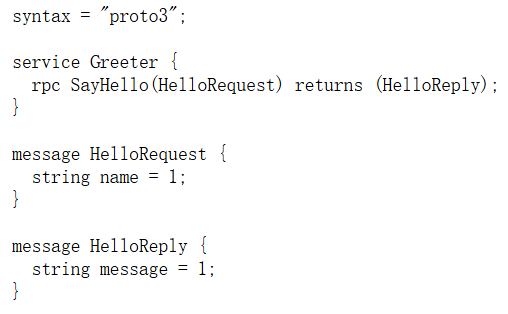
Developers define services through a .proto file, specifying RPC methods, request messages, and response
messages. The Protocol Buffers compiler (protoc) generates multilingual, strongly typed client and server stubs.
Client applications invoke methods on the generated stub as if calling local functions, while the server implements
the service interface. This approach reduces boilerplate code and minimizes serialization errors.
gRPC supports four communication types:
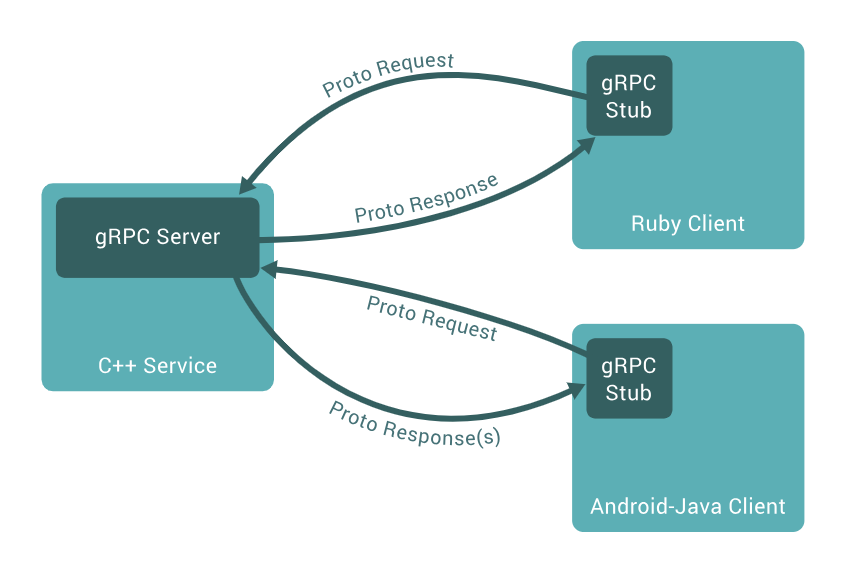
Protocol Buffers (protobuf) is a language-neutral and platform-independent serialization mechanism developed by Google, which encodes structured data in a compact binary format. Compared with text-based formats such as JSON or XML, protobuf messages are smaller and faster to parse, making them ideal for high-performance services.
The .proto file defines the message structure, including field numbers, types, and modifiers. This schema
acts as a contract between client and server, ensuring that both sides interpret data consistently. Protobuf
uses numeric tags to identify fields, allowing for compact binary encoding and efficient parsing even as
schemas evolve.
syntax = "proto3";

message Example {
  int32 id = 1;
  string name = 2;
  bool active = 3;
}
Protobuf serialization is faster and produces smaller payloads than JSON or XML. It commonly uses a tag-length-value (TLV) style encoding to minimize the load on the network. During serialization, fields are encoded with their numeric tag and wire type, then packed into a binary stream. On deserialization, the runtime library efficiently reconstructs the in-memory objects without expensive parsing of text.
Protobuf supports forward and backward compatibility through optional fields and flexible field numbering strategies. New fields can be added with unique tags without breaking older clients, and deprecated fields can be reserved to avoid reuse of tags. This makes long-term schema evolution smoother, which is critical when services and clients are deployed independently in distributed environments.
Performance indicators are important factors in measuring communication efficiency. Compared with the popular REST approach that typically uses JSON over HTTP/1.1, gRPC has significant advantages in terms of latency, load efficiency, and throughput. Its binary protocol, persistent connections, and streaming capabilities collectively reduce overhead and improve scalability.
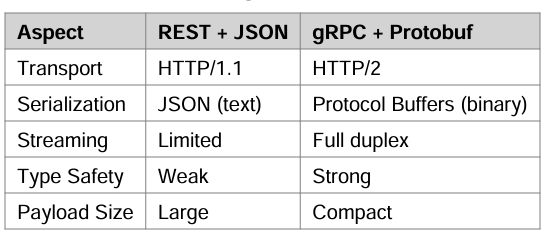
gRPC's binary protocol and persistent HTTP/2 connections reduce handshake and serialization overhead, achieving lower response times. Header compression and multiplexed streams eliminate head-of-line blocking and allow more efficient use of network resources, especially under high concurrency.
gRPC’s lightweight binary encoding reduces CPU and memory load compared to text formats such as JSON. Because messages are compact, less data is copied and processed at each stage, which lowers CPU utilization on both client and server. This is particularly beneficial for resource-constrained environments or services that must handle large volumes of requests.
Benefiting from streaming communication and multiplexing, gRPC can maintain high throughput under high concurrency. Multiple logical calls share the same underlying connection, reducing connection management overhead. Combined with load-balancing strategies and horizontal scaling, gRPC-based systems can handle substantial growth in traffic while maintaining predictable performance.
Security and reliability are key elements of microservice communication. gRPC is equipped with built-in TLS (Transport Layer Security), mutual TLS (mTLS), and various authentication mechanisms. At the same time, it integrates naturally with orchestration platforms such as Kubernetes to achieve scalable and fault-tolerant service deployments.
gRPC supports OAuth2, JWT (JSON Web Token), x.509 certificates, and other mechanisms for encrypted communication and two-way authentication. Using TLS ensures confidentiality and integrity of messages in transit, while mTLS allows both client and server to verify each other's identity. Fine-grained authorization can be implemented at the application layer using tokens or custom interceptors.
gRPC and Kubernetes are naturally compatible and can achieve horizontal scaling, service discovery, and load balancing through container orchestration. Kubernetes services and ingress controllers can distribute gRPC traffic among multiple replicas, while readiness and liveness probes help maintain healthy deployments. Integration with service meshes further enables advanced traffic management, observability, and security policies.
gRPC offers mechanisms such as retries, timeout control, and circuit breakers (often implemented via libraries or service meshes) to enhance the system's resilience to network fluctuations and temporary failures. Clients can specify timeouts per call to avoid hanging requests, and exponential backoff strategies reduce the likelihood of overloading struggling services.
Although gRPC is highly efficient, it still has limitations such as difficult debugging, browser compatibility issues, and the complexity of streaming large data sets. Addressing these challenges is crucial for broader adoption, especially in heterogeneous environments that mix web frontends, legacy systems, and modern microservices.
Because gRPC data is transmitted in a binary compressed format, it is more difficult to read directly than
JSON-based APIs. Tools such as gRPC-Web proxies, grpcurl, and ecosystem plugins for observability platforms
can partially alleviate this difficulty. Structured logging, distributed tracing, and metrics collection remain
essential for gaining insight into gRPC traffic and diagnosing problems in production.
Browser environments cannot natively initiate full HTTP/2 gRPC calls in the same way as backend services. To address this, grpc-web extends browser support for gRPC by translating between HTTP/1.1 (or HTTP/2) and gRPC on the server side. This allows web front ends to access gRPC services indirectly without abandoning existing browser APIs and infrastructure.
Possible future trends include deeper integration with GraphQL and OpenAPI tooling, simplifying schema management and client generation across different API styles. Additionally, combining gRPC with asynchronous messaging systems and event-driven architectures may further enhance interoperability, resilience, and developer experience in complex distributed systems.
gRPC and Protocol Buffers provide a modern approach to microservice communication. Through efficient serialization, persistent connections, and cross-language compatibility, they outperform traditional REST systems in many scenarios, especially when low latency and high throughput are required. Their tight integration with cloud-native platforms, security mechanisms, and streaming capabilities makes them indispensable building blocks for scalable, secure, and high-performance distributed applications.