This paper introduces a cross-layer approach to energy-efficient mesh networking for the Internet of Things (IoT). We focus on tools for reducing radio wake-up times, stable forwarding, and network-layer mechanisms for limiting control communications. This paper explores approaches at three layers: using deterministic scheduling with TSCH (Time-Slotted Channel Hopping) to shorten the necessary transmit/receive windows; buffering downlink traffic to powered nodes via Bluetooth Mesh Friendship and Thread Sleepy End Devices, allowing the battery to change from continuous listening to "briefly waking up" at fixed or negotiated intervals before immediately going back to sleep; and using negotiated wake-up scheduling with Wi-Fi HaLow TWT/RAW to reduce unnecessary waiting through scheduled wake-up.
Keywords: IoT, Mesh Network, Energy Efficiency, TSCH, Sleepy End Device, Bluetooth Mesh Friendship, Wi-Fi HaLow TWT/RAW
Battery-powered Internet of Things (IoT) deployments—such as smart buildings (smart building sensors for monitoring lighting, ventilation, or power systems in hard-to-reach areas), environmental sensing (deployed to monitor the condition of agriculture, logistics, or remote environmental studies), and vehicle monitoring (for tracking valuable assets such as trailers and vehicles in remote areas)—employ mesh networks to extend coverage and enable self-healing in the event of failure. However, while these characteristics of mesh networks enhance their robustness, they also increase energy consumption. The energy of the radio module is primarily consumed by idle listening, control plane maintenance, and retransmissions; therefore, with voltage nearly constant, the energy of a message depends primarily on the total time the radio is in the air: the longer the airtime and the more retransmissions, the faster the battery degrades.
2. Energy-efficient mesh networking for IoT
In a mesh network, each node can act as either a source or receiver of application data. This feature can improve network coverage, but can lead to uneven workload distribution. Nodes closer to the receiver tend to forward more traffic, and therefore consume battery power faster because they remain in a wake-up state for longer periods. Any increase in radio uptime almost always translates to higher energy consumption. Modern low-power protocol stacks mitigate energy consumption pressures through several mechanisms: First, TSCH provides predictable transmit and receive schedules, significantly reducing idle listening and retransmissions [RFC7554]; second, Thread's Sleepy End Device and Bluetooth Mesh's LPN/Friendship move the downlink buffer to the power supply node, with battery-powered devices only waking up and retrieving data within a short polling window, thus transforming "always-on reception" into "short-time reception" [ThreadWP22][BluetoothSIG17]; and third, negotiation wake-up scheduling based on Wi-Fi HaLow TWT/RAW reduces unnecessary waiting through scheduled wake-ups [802.11ah]. This section introduces these modules, focusing on the principle behind each mechanism.
2.1 TSCH
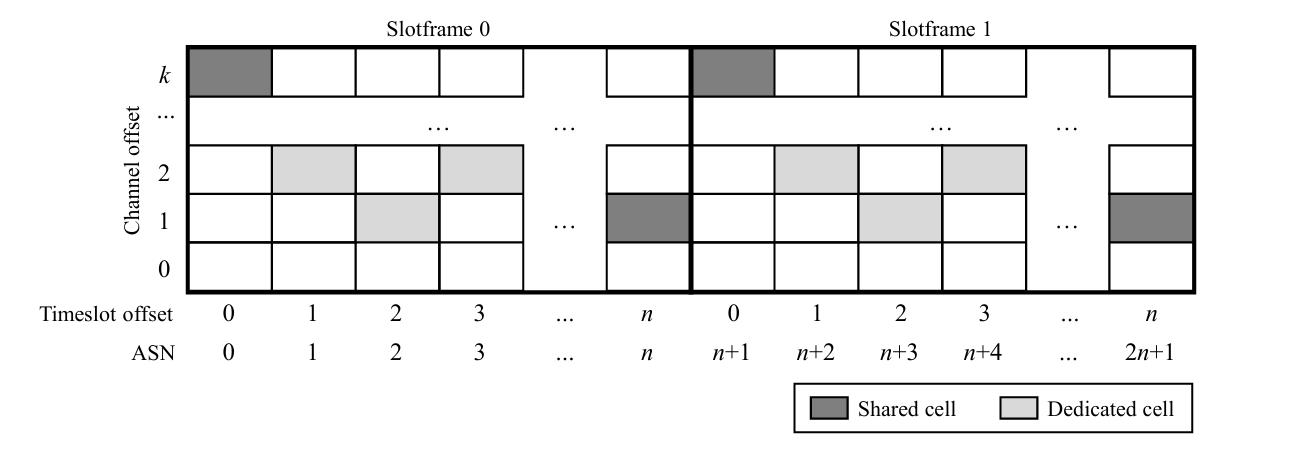
A time-structured MAC layer allows radio devices to be off most of the time and predictably turned on for short periods. TSCH achieves this by dividing time into repeating time slots; each time slot can be left idle for sleep or reserved for a specific neighbor's transceiver cell, and the center frequency used in each time slot jumps from one time slot to the next [RFC7554]. Because the reserved time slots are known in advance, nodes can turn off their receivers outside of the few time slots actually in use, avoiding the long idle listening windows common in contention-based MAC layers. At the same time, some unavoidable interference, such as microwave oven and Wi-Fi signals, can be dispersed throughout the channel set. This dispersion reduces the probability of a single transmitted signal repeatedly colliding at the wrong frequency, reducing the number of retransmissions (which increases the energy of each transmission).
2.2 Thread Sleepy End Devices and Bluetooth Mesh Friendship
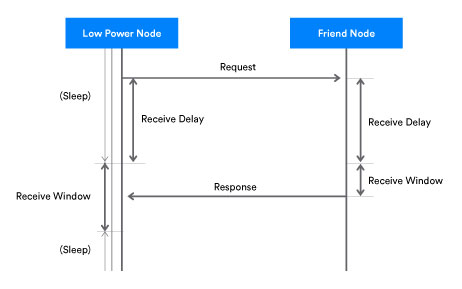
Downlink reception refers to how a sleeping device knows there is traffic to send. Thread's Sleepy End Device (SED) is a simple example: the SED designates a parent node, which buffers downlink packets while the SED is sleeping; the SED briefly wakes up at set intervals to collect the packets buffered by the parent node during this sleep period [ThreadWP22]. Because continuous idle listening is costly, the SED uses a short and predictable interval wake-up mechanism, and the interval can be adjusted. Bluetooth Mesh Low Power Nodes (LPNs) and friend nodes employ a similar pattern in mesh networks. The friend node first buffers the downlink traffic of the LPN, then releases this traffic within a negotiated friend wake-up window [BluetoothSIG17]. Generally, longer wake-up intervals reduce average receive current but also increase the risk of data expiration. Shorter wake-up intervals have the opposite effect. Importantly, these features also concentrate power-consuming tasks on the powered nodes (such as Parent in Thread and Friend in Bluetooth Mesh), while the battery-powered nodes almost always keep the receiver off, thus saving power.
Figure 2 – ReceiveDelay and ReceiveWindow timing sequence [BluetoothSIG17]
2.3 Wi-Fi HaLow
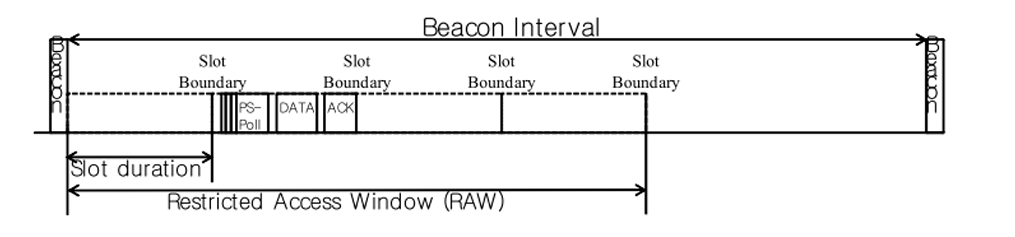
IEEE 802.11ah (Wi-Fi HaLow) is a third control mechanism: Target Wake Time (TWT) makes the wake-up time of the access point's clients or terminal devices (i.e., stations) more consistent with the access point's wake-up time; Restricted Access Windows (RAW) groups stations to ensure that only a subset of stations compete within a given time window [80211ah]. TWT saves energy by eliminating the need for stations to wait for transmission opportunities near the channel. Stations can enter a deep sleep state until their scheduled time. RAW limits the number of stations allowed to compete simultaneously, thus reducing collisions and retransmissions. In stable test scenarios, the network can use longer TWT periods, which can significantly reduce idle listening time (although it may slightly increase transmission latency).
Receiver stays off; brief scheduled polls fetch queued data
[ThreadWP22], [Darabkh22]
Bluetooth Mesh (LPN/Friend)
2.4 GHz
Managed flooding
Friendship (LPN/Friend buffer & poll)
<1% possible (tuned)
Receiver off except short friend-poll windows
[BluetoothSIG17], [Silabs21]
802.11ah (TWT/RAW)
sub-GHz
WLAN (AP–STA)
TWT appointments + RAW grouping
~1–5% (steady-state TWT)
Sleep until appointment; fewer collisions per window
[80211ah]
2.5 Summary
These mechanisms are designed to be complementary. TSCH reduces idle listening and retransmissions while maintaining stability; SED/LPN-Friend's buffering mechanism does not require the receiver to be enabled by default and binds the downlink to a short and predictable time window; TWT/RAW extends the "reservation" concept to higher data rates and wider coverage. Energy-efficient mesh networks do not rely on any single technique. These mechanisms complement each other.
3. System Model
We can divide the energy of each message into four parts to better measure energy consumption:
Transmitting Energy: Covers the entire time period during which the radio transmits the message.
Receiving Energy: Covers radio listening.
Idle Listening Energy: Covers wake-up periods without payload.
Processing Energy: Covers the work performed by the CPU when the radio is off or not in a dominant state.
These energy metrics are relevant to real-world applications, and the energy consumption data for each message can be used to improve or predict battery life.
4. Real-world Use Cases
The most typical examples are indoor sensing and lighting applications, especially those with low and periodically changing loads, which can benefit from routed IPv6 mesh networks, limiting broadcast overhead and the number of bytes transmitted over the air. Thread's SED protocol typically achieves low idle listen times in sparse to medium-density environments [ThreadWP22]. Bluetooth Mesh is also competitive in densely populated devices when using the Friendship protocol, limiting state traffic, and employing conservative TTL values. This is because Bluetooth Mesh reduces the risk of retransmissions, thereby reducing airtime [BluetoothSIG17][Silabs21]. Because urban and institutional networks generally prioritize long-term stability and coverage, operators combine TSCH scheduling with stability-oriented routing and explicit maintenance caps to avoid ongoing overhead due to weather or maintenance events [RFC7554][Darabkh22]. For industrial-grade sub-GHz backhaul links, 802.11ah provides both TWT and RAW. This is because under stable conditions, a longer TWT period can save resources, and even if there is a sudden demand, it can be adjusted temporarily without causing a high level of idle listening [80211ah].
5. Open Issues and Research Directions
Despite many methods to reduce energy consumption, high-density deployments are challenging. When multiple nodes share wireless resources, contention and retransmissions increase, resulting in inevitable high energy consumption. For radios coexisting in 2.4 GHz and sub-GHz bands, simple coexistence rules can be applied, and whenever possible, TSCH channel hopping mode can be used to avoid overlapping with the 802.11ah RAW groups. Consumption can be controlled by sending maintenance traffic within defined windows and quotas, thus avoiding excessive resource consumption from diagnostics and updates. To make tuning repeatable, feedback should be standardized: energy-related counters should be made public, and field-distributed SDN/AI controllers should be supported for automatic parameter tuning [Udayaprasad24][Debroy19]. Finally, wake-up radios (e.g., IEEE 802.11ba) can further reduce idle listening by having ultra-low-power receivers handle “doorbell” events before the main radio wakes up. Early research suggests that mesh networks hold great potential [Sanchez24].
6. Summary
Energy-efficient IoT mesh networks are a cross-layer application. Deterministic scheduling and sleep control minimize radio uptime. TSCH effectively matches relaxation time to workload; Thread and Bluetooth Mesh, combined with appropriate SED or Friendship parameters, achieve extremely low idle listening times; Wi-Fi HaLow's TWT/RAW provides on-demand power for sub-GHz backhaul links. When these are combined, the proportion of idle listening can be reduced to a very low level.
Acronyms
IoT: Internet of Things
LLN: Low-Power and Lossy Network
TSCH: Time-Slotted Channel Hopping
TWT: Target Wake Time
RAW: Restricted Access Window
LPN: Low Power Node
SED: Sleepy End Device
SDN: Software-Defined Networking
RPL: Routing Protocol for LLNs
References
[Sanchez24] R. Sanchez-Vital, C. Gómez, and E. García, "Exploring the boundaries of energy-efficient Wireless Mesh Networks with IEEE 802.11ba", Internet of Things (Amsterdam), 2024, vol. 28, article 101366.
[Udayaprasad24] P. K. Udayaprasad, J. Shreyas, N. N. Srinidhi, and S. M. N. Dilip Kumar, "Energy Efficient Optimized Routing Technique With Distributed SDN-AI to Large Scale I-IoT Networks", IEEE Access, 2024, vol. 12, pp. 2742–2759.
[Debroy19] S. Debroy, P. Samanta, A. Bashir, and M. Chatterjee, "SpEED-IoT: Spectrum aware energy efficient routing for device-to-device IoT communication", Future Generation Computer Systems, 2019, vol. 93, pp. 833–848.
[Araiza15] J. C. Araiza Leon, "Evaluation of IEEE 802.11ah Technology for Wireless Sensor Network Applications", Master’s Thesis, Tampere University of Technology, 2015.
[Kim21] D. Kim, J.-H. Kwon, and E.-J. Kim, "TSCH Multiple Slotframe Scheduling for Ensuring Timeliness in TS-SWIPT-Enabled IoT Networks", Electronics, 2021, vol. 10, no. 1, article 48.