
| Shuheng Cai, s.cai@wustl.edu (A paper written under the guidance of Prof. Raj Jain) |
Download |
Digital twin synchronization (DTS) has become more important with the development of Internet of Things (IoT), smart city, autonomous vehicle et al. This paper focus on the current DTS protocols that help DTS increase three core metrics: Timeliness, Accuracy, and Energy Efficiency. The protocols can be divided into four kinds: Network and Communication Oriented Synchronization, Task and Inference-Driven Synchronization, Resource-Aware and Optimization-Based Synchronization, and Application-Specific Synchronization. Then, this paper will introduce the current application and future directions of DTS protocols, including the current use of DTS in industrial IoT and edge networks and the future integration of Artificial Intelligence (AI), Machine Learning (ML) and Quantum technologies. Some challenges of DTS protocols will also be included. Some challenges will also be presented in this paper.
Today, the digital twin (DT) techonology is very significant in intelligent system implement. A method called DTS is the core of DT. To measure a DTS protocol, this paper suggests using three metrics: timeliness, accuracy and energy efficiency. Recent research focus on improving DTS protocols. There are different approaches to realize this. Some efforts seek to reduce bandwidth consumption in limited IoT networks, trying to reduce the synchronization error. Resource-aware practices based on mobile-edge computing are adapting frequency of synchronization and the assignment of load based on the situation on the fly. Concurrently, developing networks using AI or quantum-assisted signaling show promise for high-accuracy synchronization under 6G-enabled scenarios.
DTS focus on the correct real time consistency between a physical entity (PE) and the virtual counterpart in real and immediate time.
Tan and Matta [Tan23] defined this problem as a dynamic stochastic control problem. And the main problem is the tradeoff between new information and exiting information. They want to find a solution that can minimize the cost of DTS by the timing of DTS. Also, they try to solve synchronization problems by simulation.
Jia et al. [Jia23] generalized DTS as correlation between discovery devices such as autoregressive, with the digital world. From the sensing aspect, synchronization accuracy could be degraded if there is a temporal misalignment between distributed data sources. Nila et al. [Nila24] regarded the DTS as reducing the misalignment in the sensor networks to ensure the performance of IoT.
Effective DTS requires a set of strict system-level conditions that ensure real-time consistency between the physical and virtual entities. The synchronization protocols must minimize latency, information delay, maintain reliable data transfer and computational efficiency under resource constraints.
From the network perspective, Li et al. [Li24] demonstrated that differentiated DT instances often demand diverse synchronization frequencies depending on vehicular motion dynamics and data freshness. In computation and storage, Li et al. [Li25] proposed a joint optimization framework leveraging mobile-edge computing (MEC) to balance task offloading and synchronization frequency, showing that computational capacity and synchronization rate are deeply interdependent.
Rinaldi et al. [Rinaldi25] proposed the importance of precise time synchronization across distributed edge devices, noting that clock drift and network jitter can severely degrade the reliability of DTS in smart data centers. Moreover, Li et al. [Li23] further identified that synchronization sustainability, closely related to energy consumption, must be considered as an important requirement in large-scale using.
Performance indicators are needed to measure the performance of DTS protocol. This paper proposes three basic core metrics: Timeliness, Accuracy and Energy Efficiency which will decide the main components in DTS protocol analysis.
First, Timeliness is determined as the timeliness with when the DT is updated to capture the state of PE. Li et al. [Li23] formalized the concept as Age of Information (AoI), which will measure the trade-off between synchronization timeliness, distortion and sustainability. They divided this system into sensing and computation, resulting with shorter AoI suggests increased synchronization timeliness which is important for real- time applications.
Second, Accuracy is often measure of the proximity of the digital and physical states modeled with the aid of synchronization error (SE). Choi et al. [Choi25] used SE to measure the errors which AoI can’t reflect. And they also point out that minimizing SE allows DTS to stay consistent which will be higher when the interface task length is long if data throughput is high.
Third, Energy Efficiency measures the balance between DTS quality and power consumption. Li et al. focuses on this problem. In the MEC-supported DTS, they investigated this link [Li25]. Also, they considered sustainability and energy cost with long-term operational stability [Li23]. Energy efficiency quantifies the trade-off between synchronization quality and power consumption.
DTS essentially depends on efficient and accurate data transfer between PE and VE. At the network and communication level, DTS protocols want to keep updates coming along at the communication layer with shorter Timeliness and higher Accuracy in the proper time.
Kalasapura et al. [Kalasapura23] propose a DTS protocol called TwinSync which uses limited bandwidth IoT. They give the operator intends which allow the operator to define the application-specific notion. They find that using TwinSync can provide the same or greater accuracy while sending significantly fewer bytes than other bandwidth-insensitive synchronization approach.
Nila et al. [Nila24] proposed a framework using a publish-subscribe model in which sensors are subscribers and synchronization devices to publish. A dataset of synchronized data is important because it will help train machine learning models as well as establishing DTS. This will help DTS to be shorter Timeliness and more Accuracy.
On a bigger DTS scale, Rinaldi et al. [Rinaldi25] regards the edge-enabled data centers as significant that clock drift and network jitter can disturb the DTS in smart city. They also recommend some protocols to solve these problems such as The Network Time Protocol.
These DTS studies suggest that network and communication level DTS is at the heart of DTS, which significantly influence the Timeliness and Accuracy of DTS protocol.
DTS protocols with task and inference-based intervals or data volume updating are used to adapt in real-time based on evolving situation of inference workloads. The protocol ensures DTS resources to be allocated correctly to Timeliness and Accuracy.
Choi et al. [Choi25] used SE to examine that the optimal task length of inference is independent of the interval and delay time, instead the synchronization sensitivity parameter is the key. Showing that the best DTS protocols can minimize SE and maximize the successfully inference task bits.
In the vehicular digital twin networks, Li et al. [Li24] presented a solution to provide the DTS frequency and optimal synchronization data ratio for each vehicle. They built a decision process using the Markov Decision Process (MDP) and twin delayed deep deterministic policy gradient (TD3) to achieve enhanced synchronization with different network conditions. They showed their ideas in the figure 1, describing a real vehicle DTS system model.[Figure 1]
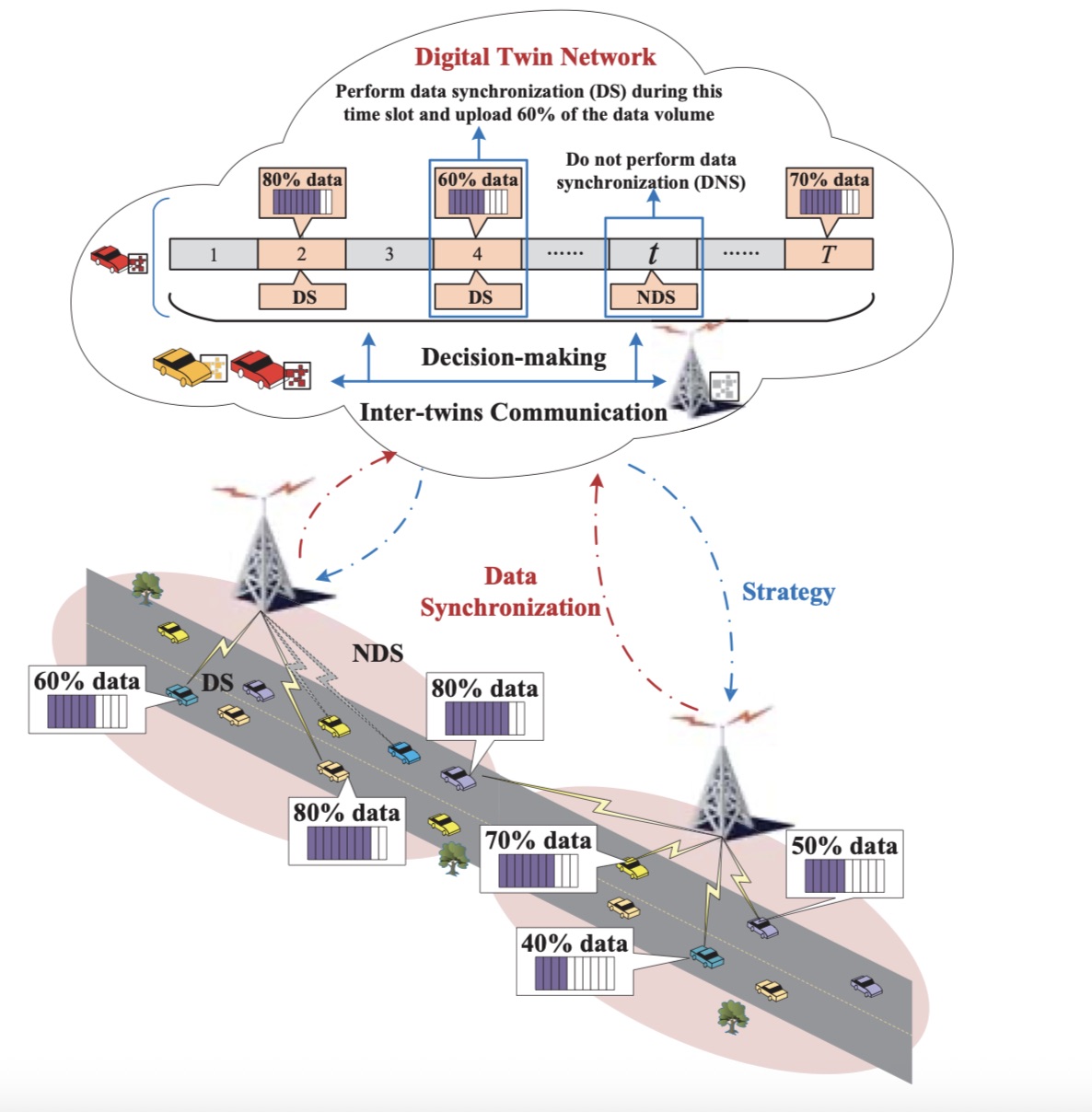
Figure 1: Li's System Model
Similarly, Li et al. [Li25] examined synchronization from MEC where the frequency and offloading of DTS is optimized at the same time so that Accuracy and Energy Efficiency can be balanced at the same time.
When combined, these works show that a data model with inference-aware synchronization mechanism-based DtS mechanism can facilitate intelligent timing of update adjustment in digital twin can adjust intelligently, making more Accuracy and Energy Efficiency to automatic update which helps in dynamic environment.
The synchronization of digital twin systems (DTS) cannot be taken lightly, as the synchronizements occur in real communication bandwidth, computational resources and electricity cost is limited. Recent studies aim to develop optimization-based methods that define DTS as multi-objective or constrained resources allocation challenges to manage the synchronization, enabling its efficient and sustainable integration. Such techniques seek to establish the best matching synchronization frequencies, volumes of data and methods of scheduling tasks with the aim of jointly increasing accuracy and reducing cost.
Li et al. [Li25] proposed a MEC-based optimization framework that integrates synchronization frequency and task offloading strategy. They established an integer linear programming (ILP) problem to build the synchronization control, derived exact and heuristic algorithms which were used to generate near perfect synchronization efficiency, while keeping communication and energy available. They showed adaptive frequency selection of synchronization greatly increased utility in real-time dynamic workloads.
Under a theoretical framework, Tan and Matta [Tan23] studied the DTS problem with a general optimization framework that includes communication delays, update cost and system-level performance metrics. This analysis established a basis for how synchronization goals can be mathematically described and balanced.
The design of DTS protocols is currently used in the intended application, such as healthcare, and augmented reality. In these applications, Accuracy and Timeliness is very important and DTS must satisfy unique requirements, especially human-system communication.
For health care, DTS must be accurate between patient’s data streams with their virtual counterpart, digitally based copy is needed. So, Lee [Lee24] designed a DTS protocol on medical healthcare settings, which will secure Timeliness to make sure the real time remote diagnosis. They build a system to guarantee reflections of physiology and clinical values from PE to VE. This system is consisting of medical care DTS layer, cyber-physical DTS layer, medical health care simulation layer and trial layer making this system possible to implement.
Another dynamic application field of DTS is in vehicular networks. Preethi et al. [Preethi25] introduce QSync-Twin6G, an accelerated vehicular synchronization architecture using quantum entanglement to deliver ultra-target accuracy and low latency synchronization in autonomous vehicular environments.
DTS protocols apply to AR can guarantee good performance between the PE and VE. Dani and Supangkat [Dani22] concluded integration approaches based on AR and DTS techonology, showing that the DTS is very important and needed in AR. They point out that DTS of AR is especially important to realize Geographic VirtualCity Miniature (GeoVCM).
Industrial Internet of Things (IIoT) and edge computation are the most challenging applications of DTS. With so many distributed PE and so many data exchanges in the physic systems such as manufacturing, energy management, and industrial automation. So DTS protocols are so important that any improvement in Timeliness, Accuracy and Energy Efficiency can make a different.
Nila et al. [Nila24] introduced a publish-subscribe model to reduce misalignment of the time between PE and VE. Our paper introduced this above.
Similarly, Jia et al. [Jia23] proposed a concurrent end-to-end synchronization and multi-attribute data resampling scheme to the digital twin construction, which enables efficient and accurate digital twin construction. This method allows a real-time multi-sensor integration, improving the accuracy of predictive maintenance and process optimization in manufacturing systems.
At infrastructure level, Rinaldi et al. [Rinaldi25] investigated time synchronization issues for edge-based data centers, where clock drift, network jitter and protocol limitations frequently resulted in collision in distributed DTS deployments. They emphasize the crucial role of good timing synchronization at-edge device level for supporting high-speed industrial changes.
In the framework of the Industry 4.0, Javaid et al. [Javaid23] analyzed the increasing adoption of digital-twin frameworks for the manufacturing and energy industries. The authors highlight the role of timely synchronization and data integration of edge devices and centralized twin architectures in predictive maintenance and operational optimization. In conclusion, IIoT and edge systems synchronization requires scalable and energy-aware solutions to achieve real-time consistency of heterogeneous distributed systems.
Future work is expected to combine edge intelligence and federated synchronization control to realize adaptive and collaborative DTS in multiple industrial sites.
Nowadays, AI, Machine Learning (ML), and Quantum Computing are very popular area in networking. Combing these technologies, DTS can be more efficiency with shorter Timeliness, higher Accuracy and more Energy friendly.
Tan et al. [Tan24] created a Stackelberg game model using ML-based to achieve quick DTS. Meanwhile, Preethi et al. [Preethi25] described a quantum-assisted synchronization protocol (QSync-Twin6G), which employs entanglement to achieve ultra-low latency and high accuracy. Outside of conventional synchronization paradigms, the integration of Digital Twin with Augmented Reality (AR) improves a visualization and interactivity of synchronized virtual models that foster intuitive decision-making and real-time monitoring.
Dani et al. [Dani22] reviewed how AR integration enhances the user perception and operational feedback loops of DTS systems, with an emphasis on the health and maintenance scenarios. Recent developments are Faster-Than-Nyquist (FTN) signaling with the intention of boosting spectrum efficiency with high-speed DTS links.
Baek et al. [Baek23] have applied an LSTM interference cancellation approach to protect synchronization accuracy in multipath context and emphasize the potential and efficiency of machine-learning-based PHY-layer optimization in new DTS architectures.
Collectively, these efforts demonstrate that a fusion of AI, AR, ML, and quantum paradigms can be used to realize intelligent, adaptive —and highly dependable — synchronization schemes through smart, scalable and energy-efficient digital twin systems.
Despite this significant progress, major limitations are still associated with the DTS. First, scalable and low latency synchronization is still difficult in large scale and heterogeneous networks with heterogeneous communication and computation parameters that differ in real time.
Second, achieving data consistency and time precision in the face of unstable network systems or edge–cloud coordination adds further complications. Another problem is the security and privacy as the data transmission from twin-to-physical twins in real time gives sensitive operational information.
In addition, the addition of AI/ML-based synchronization calls into question interpretability, stability, and real-time decision reliability. Finally, quantum-enabled and cross domain synchronization requires a new standardization and interoperability framework. Therefore, overcoming these open issues will be necessary for building reliable, autonomous, and sustainable DTS architectures in the emerging 6G and intelligent industrial environments.
DTS has become a critical enabler for achieving real-time synchronization of diverse PE and VE in industrial IoT, vehicular systems, intelligent edge networks, etc. In this area, this work provides a systematic overview describing current development of the DTS frameworks that are categorized into network‐oriented, task‐driven, optimization‐based, and intelligent synchronization protocols.
By contrasting synchronous core objectives (timeliness, accuracy, and energy efficiency) with the ones to which its design is matched, this study highlighted trade‐offs that dictate synchronization behavior with constraints of resources.
Additionally, several recent advances in AI-assisted inference, reinforcement learning optimization, quantum-enhanced communication, and FTN signaling have illustrated a clear trend of ongoing progress towards intelligent and adaptive synchronization approaches.
Yet, many open problems persist such as multi-domain interoperability, scalable cross-layer coordination, and security-aware synchronization for edge–cloud collaboration. These can be expanded to focus on the development of unified synchronization protocols for precision, latency, and sustainability in a diverse set of conditions. DTS will enable next-generation cyber-physical ecosystems to build smarter, more autonomous, and resilient digital twin systems.