
| Ke Jin (A paper written under the guidance of Prof. Raj Jain) |
Download
|
Optical networking has been evolving through three generations of technology to address the outburst of high-speed data communication traffic. The rapid growth of data traffic caused by immersive media, AI computing, and edge services calls a serious question upon existing fixedgrid wavelength systems. In this survey, we summarize three generations of optical networking systems in development, namely, Elastic Optical Network (EON), Softwae-Defined Optical Network (SDON), and emerging all-photonic infrastructures that are foreseen for 6G.We discuss these paradigms in the context of ongoing industrial activities, including IOWN initiative, in which optical and electronic technologies are becoming more and more integrated through intelligent orchestration; and the major threads are dynamic spectrum, programmable control, virtualization and photonic-electronic integration.From academic and industrial [8][9] published reports, in this paper we provide the comparision of the performance trend of the spectral efficiency, latency and energy consumption, and state why the all-photonic optical communication will eventually be realized.
Keywords: APN; EON; SDONs; SDM; IOWN; 6G; Network; OpenFlow
The global demand for network capacity has surged with the expansion of cloud computing, IoT, and AI-driven services. Conventional wavelength-division multiplexing (WDM) networks, which once met steady traffic needs, now appear rigid when facing rapidly changing workloads. Their fixed 50-GHz channel grid and unvarying modulation leave spectral gaps and hinder efficient spectrum use. To address these issues, researchers proposed Elastic Optical Networks (EONs), which introduce flexible frequency spacing and adaptive modulation formats [1].
As shown in Fig. 1, an EON dynamically adjusts its allocated spectrum according to the traffic load, allowing several chanels to share frequency resources more precisely. This adaptability enables better control of capacity and more balanced energy consumption across optical channels.
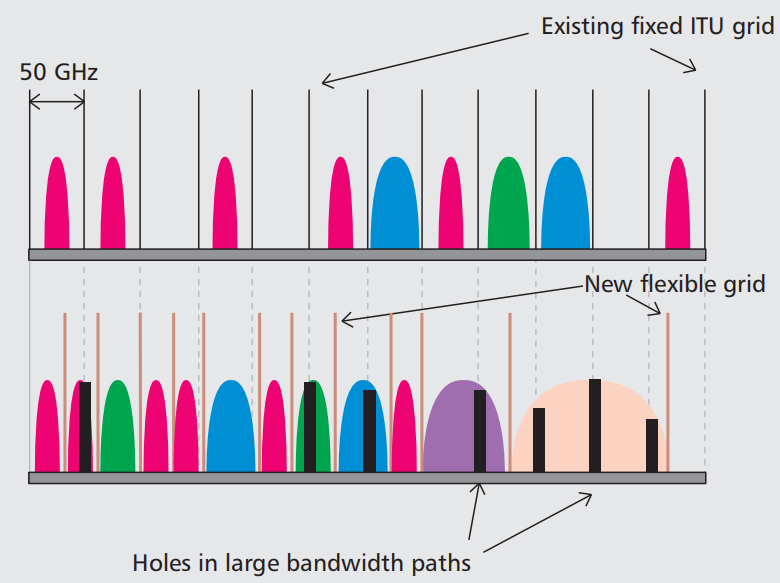
Building on this principle, Software-Defined Optical Networking (SDON) emerged as a natural extension.. By transferring control logic from hardware to software, SDON follows the Software-Defined Networking (SDN) concept that separates control and data planes [2]. Such separation enables centralized decision-making and rapid network reconfiguration. In practice, operators can establish or reroute lightpaths through the controller without manual intervention—a major improvement for modern transport systems.
Further progress arrived with Space-Division Multiplexing (SDM), which multiplies transmission capacity by exploiting multiple cores or modes within a single fiber [3]. Together, EON, SDON, and SDM form the foundation of the All-Photonic Network (APN) concept promoted in the IOWN framework. This design aims to remove electronic bottlenecks by keepping the signal entirely in the optical domain, offering sub-millisecond latency and roughly two orders of magnitude energy savings compared with conventional switching [4].
Industry analyses, such as Networking Trends 2025, identify open APN architectures and hollow-core fiber (HCF) systems as near-term enablers of 6G-class connectivity [8]. The convergence of optical hardware, SDN programability, and AI-based orchestration indicates a clear shift toward energy-efficient, data-centric networks. The following sections discuss this transition in detail, beginning with the principles and implementation of EONs.
Elastic Optical Networks (EONs) were introduced to overcome the spectral rigidity of traditional Dense Wavelength Diviision Multiplexing (DWDM) systems based on a fixed 50 GHz grid [5]. Instead of assigning each wavelength as an indivisible slot, EONs divide the optical spectrum into finer units — typically 12.5 GHz or 6.25 GHz — so a connection uses only as many slots as required by its bitrate and modulation format. This departs from the static ITU-T G.694.1 standard and allows on-demand adaptation.
Bandwidth-variable transponders (BVTs) and bandwidth-variable optical cross-connects (BV-WXCs) make this adaptability feasible [1]. They adjust modulation and slot allocation in real time based on traffic conditions. The spectral efficiency η can be approximated as
$$ η=\frac{R_b(1-{δ_{FEC}})}{B_c} $$where \(Rb\) is bit rate, \(Bc\) the allocated channel bandwidth, \(δFEC\) the forward-error-correction overhead, and the modulation format determines the number of bits per symbol (e.g., QPSK = 2, 16QAM = 4).
EONs bring several operational benefits:
Empirical evaluations report up to 40-60 % improvement in spectrum utilization and ≈30 % lower blocking probability under dynamic traffic compared with legacy WDM systems [5]. Flex-grid operation also supports multi-band integration (C + L or O + C bands), paving the way toward transparent multi-domain photonic networks [6].
The key algorithmic challenge for EON is the Routing and Spectrum Allocation (RSA) problem. Compared with Routing and Wavelength Assignment (RWA) in WDM, RSA must simultaneously meet continuity and contiguity constraints [1]. Each connection request requires: (1) path selection, (2) assignment of a contiguous slot block with sufficient capacity, and (3) availability of that block along all links.
Because RSA is NP-hard, heuristics such as First-Fit (FF), Most-Used (MU), and Fragmentation-Aware Routing (FAR) are used in practice. Fragmentation reflects how discontinuous free spectrum is and can be measured by
$$ F_r=1-\frac{\sum_{i}{S_i^2}}{{{\left ({\sum_{i}{S_i}}\right )}^2}} $$Where \(Si\) is the size of each free spectral block. Lower \(F\) indicates higher spectrum contiguity and thus lower blocking probability.
Trials by operators such as Telefónica and Orange have verified that flex-grid transponders and ROADMs conforming to ITU-T G.694.1 achieve around 40 % higher spectral efficiency than DWDM. Fig. 2 shows a multi-layer testbed connecting metro and core domains [1]. These deployments confirm that EON technology is commercially viable and ready for programmable optical infrastructure.
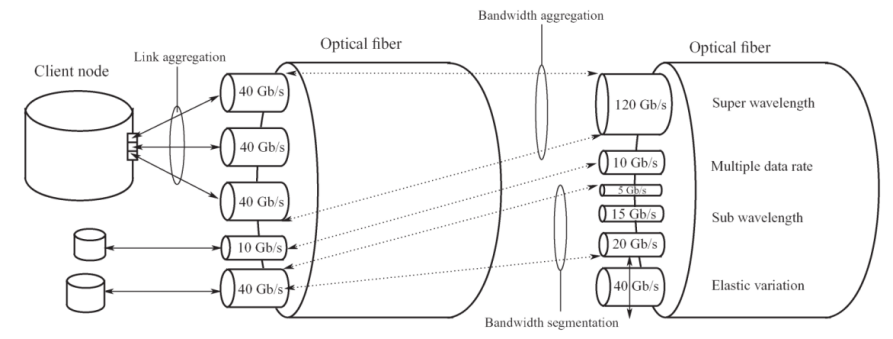
Software-Defined Optical Networking extends the SDN idea to the optical layer, bringing programmability and centralized control across multiple planes. Functions are separated into data, control, management, and application planes, which simplifies coordination [2].
The control plane, often implemented with the OpenFlow protocol, installs flow rules into optical devices such as ROADMs and OXCs [9]. A central controller can then configure and restore lightpaths according to real-time conditions. Fig. 3 illustrates this multi-plane structure.
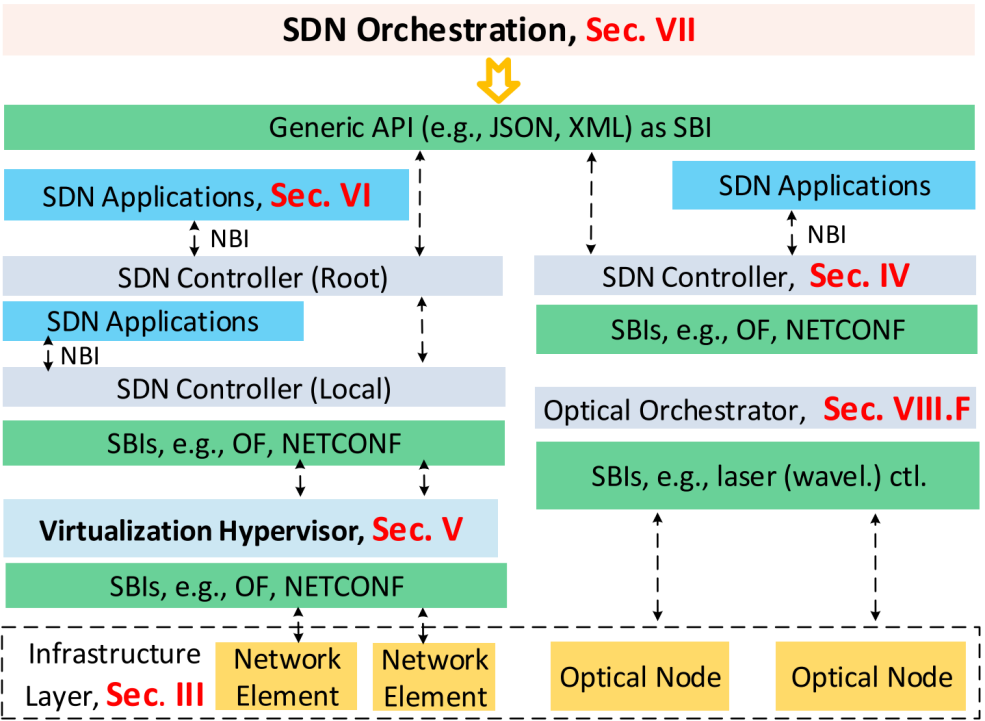
Such architecture simplifies management of heterogeneous equipment and supports network slicing and optical virtualization that were previously hardware-dependent. Operational experience shows that SDONs reduce reconfiguration time from minutes to seconds and improve resource utilization [2].
Early OpenFlow versions (v1.0) focused on Ethernet switching. Later releases (v1.3 to v1.5) added optical and multi-protocol support [9]. However, its fixed header structure limits flexibility because each new protocol needs a specification update. To address this, the P4 language (Programming Protocol-Independent Packet Processors) was developed to let designers define their own parsers and match-action logic.
For optical systems, P4 compilers can target photonic switch ASICs, allowing path reconfiguration through software rather than hardware changes. The flow-management optimization goal is typically
$$ {\min_{{f_{ij}}}\sum_{i,j}{{C_{ij}}}}({f_{ij}})\text{, }subject\text{ }to\sum_{j}{{f_{ij}}}≤B_i\mathrm{} $$where \(Cij\) represents flow cost and \(Bi\) the bandwidth constraint on each link.
The open and compiler-oriented nature of P4 allows for protocol-independent control of photons — a change from the control-versioned nature of protocols to behavior-oriented definition of forwarding — as users but not vendor equipment manufacturers encode forwarding behavior.
Virtualization is central to scalable SDONs. Open vSwitch (OVS) acts as the virtual switch layer, while OVSDB handles lightweight JSON-based configuration [9]. Together with SDN controllers, they enable dynamic creation of virtual optical links and extend cloud-style orchestration to the transport layer.
The contrast between OpenFlow and P4 in optical applications can be summarized as follows [9]:
| Feature Category | OpenFlow | P4 (Programming Protocol-Independent Packet Processors) |
|---|---|---|
| Protocol Support & Parsing | Fixed header fields; parser tied to version updates for new protocols | Protocol-independent programmable parser supporting arbitrary L2–L5 formats. |
| Programming Flexibility | Controller installs flow rules via OpenFlow API; hardware-specific TCAM tables. | Platform-agnostic compiler generates target code; behavior defined in P4 source, not protocol spec. |
| Extensibility | Limited; adding new headers or actions requires OpenFlow revision. | Fully extensible; supports new field definitions and match-action logic dynamically. |
| Scalability & Deployment | Multi-table flow rules; control overhead grows with network size; slower adaptation. | Compiled low-level instructions enable efficient scaling and rapid reconfiguration. |
| Optical System Adaptability | Centralized SDN control applied to optical switches, but lacks protocol agility. | Supports reconfigurable packet/flow parsing for programmable photonic-electronic integration. |
Overall, this comparison describes a shift from protocol dependence and into a protocol independent regime, where optical behavior is dictated by software rather than fixed protocol stacks. When SDONs leverage such models optical networks become programmable spaces that can directly integrate with AI enabled orchestration solutions [8].
Spectrally-spatially flexible optical networks (SS-FONs) extend EON principles to include spatial dimensions. Multiple cores or modes in a fiber act as parallel spatial channels, dramatically increasing throughput. Combined with elastic spectrum allocation, these networks achieve petabit-scale capacity [3]. Fig. 4 illustrates this concept.

Resource allocation in SS-FONs generalizes RSA to Routing, Modulation, and Spectrum-Spatial Assignment (RMLSSA). This problem optimizes a 4D resource space—{path, modulation, spectrum, core}—under interference and crosstalk constraints:
$$ {\max_{{x_{p,m,s,c}}}\sum_{p,m,s,c}{U}}({x_{p,m,s,c}}) $$The RL-based solvers demonstrated faster converge speed and more flexibility to different traffic patterns.
Fragments (spatially and spectrally) reduce performance; adaptive core assignment and dynamic defragmentation help alleviate this impact. XT-RSA algorithms integrate power optimization and mode isolation mechanisms for crosstalk-aware RSA (crosstalk aware RSA [4]).
All-photonic networks (APNs) represent the final step in the optical evolution chain. They replace all electronic packet switching with photonic switching, achieving near-zero electronic processing delay. In Networking Trends 2025, APNs and Hollow-Core Fibers are spotlighted as high-impact technologies driving 6G readiness[8].
The IOWN Global Forum, established by NTT, Intel, and Sony, coordinates standardization and research on end-to-end photonic infrastructures. IOWN's Data-Centric Infrastructure (DCI) promises 100x energy efficiency and 125x bandwidth density compared to current IP-based systems [4]. Fig. 5 shows this concept.
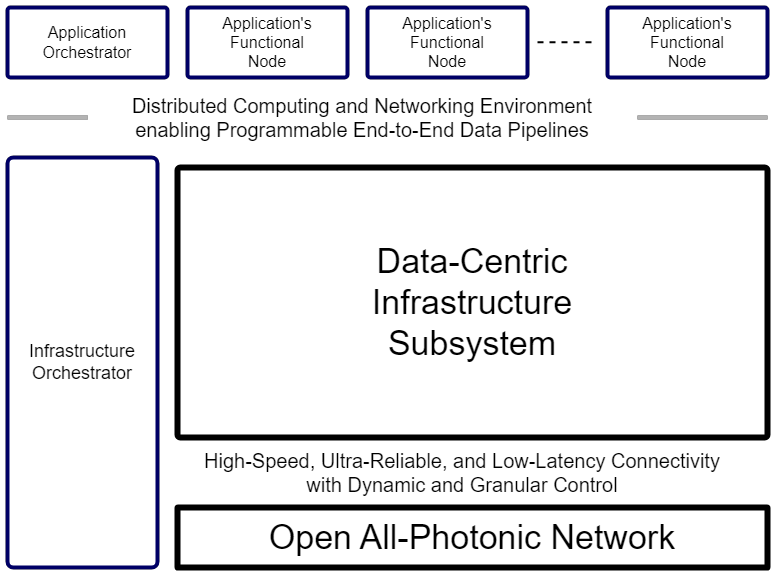
The APN architecture applies SDN principles at the photonic layer. Optical cross-connects become programmable flow devices, enabling end-to-end lightpath control. Through OpenFlow-based orchestration, photonic wavelengths, cores, and polarizations can be dynamically assigned, creating a software-defined photonic fabric.
Experimental testbeds—like NTT's photonic interconnect platform—achieved 1 Tbps core-to-core throughput with 50% lower energy consumption. Similarly, KDDI's OpenAPN field trial demonstrated real-time AI-based path optimization across metro domains. These cases validate the scalability and reliability of photonic programmability.
In the future generation of optical networks we envisage a hierarchical SDN control to deal with the multi-domain network. High level policies are controlled with global controllers, whereas regional domains are handled by local ones through open APIs (TAPI, RESTCONF). The policy enforcement facilitates vendors and transport layer independence.
Machine learning (ML) has been identified as an enabling technology for optical-network automa-tion by providing real-time intelligence to close the gap between SDN and NFV controllers, programmable control planes, and endusers; Rafique and Velasco [7] propose a layered automation framework with ML modules deployed in hierarchical architecture, processing continuous telemetry information about optical network equipment such as transceivers, amplifiers, and ROADMs.The derived architecture enables closed-loop optimization for the three functional layers; data analytics, decision intelligence, and actuation.
Quality-of-transmission (QoT) estimation and bit-error-rate (BER) prediction is performed using supervised learning methods like random forests and support-vector machines instead of traditional analytical models that are costly to be calibrates. Unsupervised machine learning techniques, such as clustering and dimension-reduction methods, are used for anomaly detection and trafficpattern discovery of multi-layer transport networks.All of these ML blocks are either called by SDN controllers over northbound APIs to initiate a reconfiguration step (e.g., mod-format adaptation, optical-path rerouting).
Reinforcement learning (RL) extends this paradigm toward self-driven optimization. By modeling spectrum and power allocation as a Markov-decision process, RL agents learn to minimize blocking probability and power consumption under varying traffic loads. Experimental results in [7] show that deep-Q-learning controllers can reduce reconfiguration delay by ≈25 % compared with heuristic algorithms. Integration with big-data platforms (e.g., Spark Streaming) enables real-time inference, supporting proactive failure localization and service-level-agreement (SLA) compliance monitoring.
Network Edge Virtualization Virtualization of the network edge - including the integration of APN backbones to mobile edge computing (MEC) - can allow AI model offload for application use cases such as holographic telepresence in the 6G use cases.
The transformation of optical networking from rigid wavelength systems to flexible, programmable, and fully photonic infrastructures reflects a broader evolution in network design philosophy. Each technological stage—Elastic Optical Networks, Software-Defined Optical Networks, and the emerging All-Photonic Network—has addressed a distinct limitation of its predecessor. EONs introduced spectrum agility and improved utilization; SDONs extended control-plane programmability and multi-layer automation; APNs now aim to remove the final electronic bottleneck through end-to-end photonic switching and integration within the IOWN framework [4][8].
These advances are not isolated improvements but interdependent elements of a convergent architecture that links hardware, software, and intelligence. The introduction of OpenFlow and later P4 has blurred boundaries between packet and optical layers, allowing uniform orchestration and virtualization across domains. Meanwhile, machine-learning-based management continues to shorten reconfiguration cycles and enhance reliability in complex transport environments [7].
As 6G networks mature, photonic systems will carry not only higher bandwidth but also adaptive intelligence at the control layer. Future research should focus on scalable photonic virtualization, P4-compatible hardware, and reinforcement-learning-driven optimization. The resulting infrastructure will combine speed, flexibility, and sustainability—key traits of a network capable of meeting the data-centric demands of the next decade.
[1] “Routing and Spectrum Allocation in Elastic Optical Networks: A Tutorial,” B. C. Chatterjee, N. Sarma, and E. Oki, IEEE Communications Surveys & Tutorials, vol. 17, no. 3, pp. 1776-1800, 2015.
[2] “Software Defined Optical Networks (SDONs): A Comprehensive Survey,” A. S. Thyagaturu, A. Mercian, M. P. McGarry, M. Reisslein, and W. Kellerer, IEEE Communications Surveys & Tutorials, vol. 18, no. 4, pp. 2738-2786, 2016.
[3] “Survey of Resource Allocation Schemes and Algorithms in Spectrally-Spatially Flexible Optical Networking,” M. Klinkowski, P. Lechowicz, and K. Walkowiak, Optical Switching and Networking, vol. 27, pp. 58-78, 2018.
[4] “Progress of an All-Photonic Network for a 6G Mobile Network in the IOWN Global Forum, K. Miyamoto, Y. Sugai, and R. Inohara, Journal of Optical Communications and Networking, vol. 17, no. 11, pp. E9-E16, 2025.
[5] “Elastic Optical Networking: A New Dawn for the Optical Layer,” H. Jinno et al., IEEE Communications Magazine, vol. 47, no. 11, pp. S33-S39, 2009.
[6] “Disaggregated and Transparent Multi-band Optical Continuum Networks,” I. Tomkos et al., IEEE/OSA Journal of Optical Communications and Networking, vol. 15, no. 4, pp. 272-285, 2024.
[7] “Machine Learning for Network Automation: Overview, Architecture, and Applications,” D. Rafique and L. Velasco, IEEE/OSA Journal of Optical Communications and Networking, vol. 10, no. 10, pp. D126-D143, 2018.
[8] “Networking Trends 2025,” R. Jain, Washington University in St. Louis, 2025.
[9] “Introduction to OpenFlow,” R. Jain, Washington University in St. Louis, 2025.
[10] “IOWN-GF-RD-Open_APN_Functional_Architecture-2.0,” IOWN Global Forum, technical document.